
The Ruthless History of State Atheism: Church Destruction in Soviet Union, Albania and Mexico
A prevalent appealing narrative has been spread, especially after Facebook came, which is—
“Religious people are very extremist, they don’t allow freedom of speech, they don’t like dissenting opinions. They forcefully impose their views on others. On the other hand, atheists are very civilized. They always welcome free thought and dissenting opinions, they are the living embodiment of freedom of speech.”
This is a one-sided narrative. It’s not that religious people don’t do such things—they do. Everyone does this. Even supporters of democracy forcefully establish democracy. Human rights are also forcefully imposed.
Similarly, atheists have also forcefully imposed atheism on ordinary people, in the name of atheism, they have committed murders and violence to establish atheism, and have suppressed freedom of speech. But these are not discussed in the same way. I will give some examples from history:
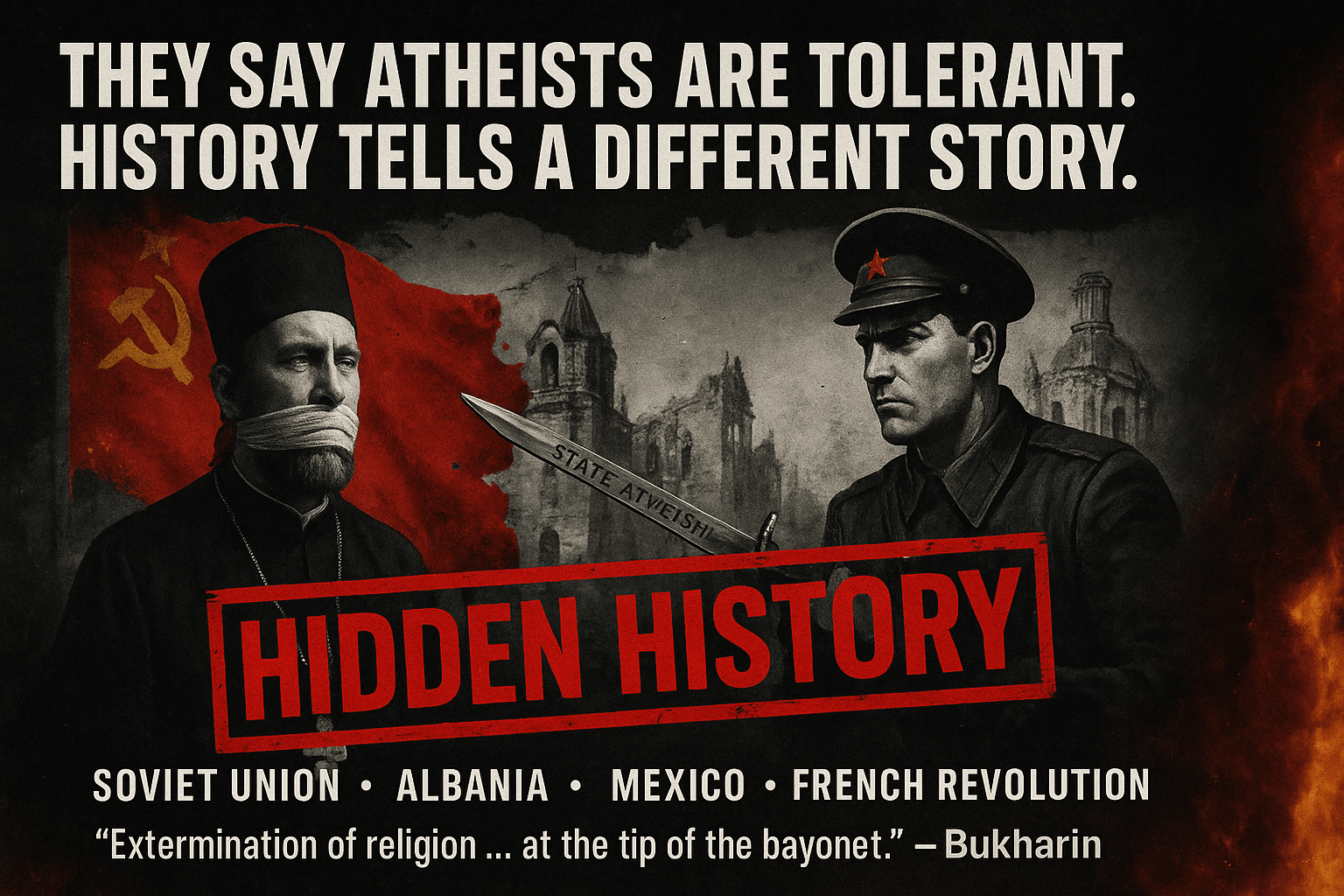
Soviet Union
In the Soviet Union, after the Bolshevik Revolution of 1917, atheist revolutionaries implemented atheism as state religion, namely Gosateizm, that is, State Atheism. The rulers of the Union waged war against religion for a long 70 years, killing priests, clergy and mullahs.[1]Paul Froese. Forced Secularization in Soviet Russia: Why an Atheistic Monopoly Failed. Journal for the Scientific Study of Religion. They printed anti-religious newspapers at the state level, taught atheism in schools and colleges. With state support, the League of Militant Atheists was formed in 1925, whose job was to spread propaganda against religion, torture priests, clergy and mullahs.[2]Godfrey Blainey, A Short History of Christianity, p 494. They undertook the Godless Five Years Plan, their goal was to completely erase religion from society and replace it with atheism.[3]Anderson, John. Religion, State and Politics in the Soviet Union and Successor States, Cambridge University Press, p 3.
They were so intolerant that if anyone criticized atheism or the government’s activities, the state would forcefully retire them or put them in jail.[4]Pospielovsky, Dimitry. A History of Soviet atheism in theory and practice and the believer, vol 2. According to researchers, atheists carried out the largest forced mass conversion in modern times—
“It Might be Added that the most modern example of forced ‘conversios’ came not from any theocratic state, but from a professedly atheist government – that of the Soviet Union under the Communists.”[5]Adappur, Abraham. Religion and Cultural crisis in India and west.
According to one account, from 1922 to 1926 alone, 28 Orthodox bishops and 1200 priests were killed and many were tortured. During 1929–1941, nearly 98% of churches were closed.
Albania
In 1967, Albania’s head of state Enver Hoxha declared Albania “the world’s first atheist state,” after which the country’s total 2,169 religious institutions (including 268 Catholic churches) were destroyed or closed.”[6]Albania: An atheist state, Bernhard Tonnes, p 6.
The religious people of Albania faced oppression under atheist rule. They officially abolished religious symbols, clothing and practices. Religious leaders were brought under the law. Basically, the atheist ruling class claimed that religion was a foreign thing in Albania. With this reasoning, they suppressed religion from 1967 to 1991.[7]Representations of Place: Albania, Derek R. Hall
In 1972, Catholic priest Shtjefen Kurti was sentenced to death and hanged for the crime of secretly baptizing a child in the city of Shkoder. Later in 1990, the policy of state atheism was abolished in Albania.
Mexico
Articles 3, 5, 24, 27 and 130 of Mexico’s 1917 constitution included anti-religious clauses. After President Plutarco Elías Calles came to power in 1924, he strengthened this law further. Mexico during Calles’ time is called an atheist state, his goal was to erase religious practice from Mexico.[8]American Catholics and Mexican Anticlericalism, 1933–1936,E. David Cronon Journal of American History, Volume 45, Issue 2, September 1958, Pages 201–230
On June 14, 1926, President Calles passed an anti-religious law, known as The Law Reforming the Penal Code or Calles Law, which intensified anti-Catholic activities. This law— banned religious groups and associations, deprived churches of property rights, and cancelled civil rights of priests.[9]Resisting Rebellion: The History and Politics of Counterinsurgency, Anthony James Joes, p. 70
Wearing clerical clothing outside the church was fined 500 pesos and priests who criticized the government were sentenced to five years in prison. Calles confiscated church property, expelled all foreign priests and closed monasteries, convents and religious schools.[10]John W. Warnock, The Other Mexico: The North American Triangle Completed p. 27
Due to strict anti-religious laws, opposition against Calles began in various states. And from this opposition, the Cristero War started from 1926–1929. Later in 1992, the Mexican government amended the constitution by granting legal status to all religious groups, granting them property rights and lifting restrictions on the number of priests in the country.
French Revolution
The revolutionaries who led the French Revolution of 1789 were secular and atheist. They were the most extreme enemies of Christianity. They attempted to Dechristianize France by massacring Christians en masse. This period of the revolution is called the Reign of Terror, during which the revolutionaries suppressed the Church, confiscated church property, exiled 30,000 priests and killed hundreds more priests.[11]Collins, Michael (1999). The Story of Christianity. pp. 176–177.
State-supported atheism was first established in France through the revolutionaries. During this time, two types of cults were created in France, the secularists’ Cult of the Supreme Being and the atheists’ Cult of Reason,[12]Kennedy, Emmet (1989). A Cultural History of the French Revolution. Yale University Press. p. 343 those priests who did not pledge allegiance to the revolutionary government were sent into exile or imprisoned. Even women were beaten on the streets on their way to church.[13]Anthony James Joes, Resisting Rebellion: The History and Politics of Counterinsurgency 2006, p. 51 Many churches were converted into Temples of reason, where atheist ceremonies were held.[14]Thomas Hartwell:An Introduction to the Critical Study and Knowledge of the Holy Scriptures. Cambridge University Press. p. 30
The most horrific incident of this time occurred in the city of Nantes, where under the leadership of Jean-Baptiste Carrier, thousands of Christian believers, men, women and even children were tied and drowned in the river—which is called Noyades de Nantes. At the same time, Infernal Columns were sent to villages, who burned churches and killed many religious people in rebellious areas including Vendée.
Whenever atheists have gained ruling power, they have become harsh against religion and religious people. They have restricted freedom of speech, suppressed dissenting opinions, and tried to forcefully impose atheism by threatening with weapons. They have killed religious women, men, elderly and even infants. Everything has happened in the name of atheism and free thought out of hatred for religion.
Finally, I will end with a quote from Pravda editor Nikolai Bukharin, who said,
“Extermination of Religion, at the tip of the bayonet.”
References
| ⇧1 | Paul Froese. Forced Secularization in Soviet Russia: Why an Atheistic Monopoly Failed. Journal for the Scientific Study of Religion. |
|---|---|
| ⇧2 | Godfrey Blainey, A Short History of Christianity, p 494. |
| ⇧3 | Anderson, John. Religion, State and Politics in the Soviet Union and Successor States, Cambridge University Press, p 3. |
| ⇧4 | Pospielovsky, Dimitry. A History of Soviet atheism in theory and practice and the believer, vol 2. |
| ⇧5 | Adappur, Abraham. Religion and Cultural crisis in India and west. |
| ⇧6 | Albania: An atheist state, Bernhard Tonnes, p 6. |
| ⇧7 | Representations of Place: Albania, Derek R. Hall |
| ⇧8 | American Catholics and Mexican Anticlericalism, 1933–1936,E. David Cronon Journal of American History, Volume 45, Issue 2, September 1958, Pages 201–230 |
| ⇧9 | Resisting Rebellion: The History and Politics of Counterinsurgency, Anthony James Joes, p. 70 |
| ⇧10 | John W. Warnock, The Other Mexico: The North American Triangle Completed p. 27 |
| ⇧11 | Collins, Michael (1999). The Story of Christianity. pp. 176–177. |
| ⇧12 | Kennedy, Emmet (1989). A Cultural History of the French Revolution. Yale University Press. p. 343 |
| ⇧13 | Anthony James Joes, Resisting Rebellion: The History and Politics of Counterinsurgency 2006, p. 51 |
| ⇧14 | Thomas Hartwell:An Introduction to the Critical Study and Knowledge of the Holy Scriptures. Cambridge University Press. p. 30 |